
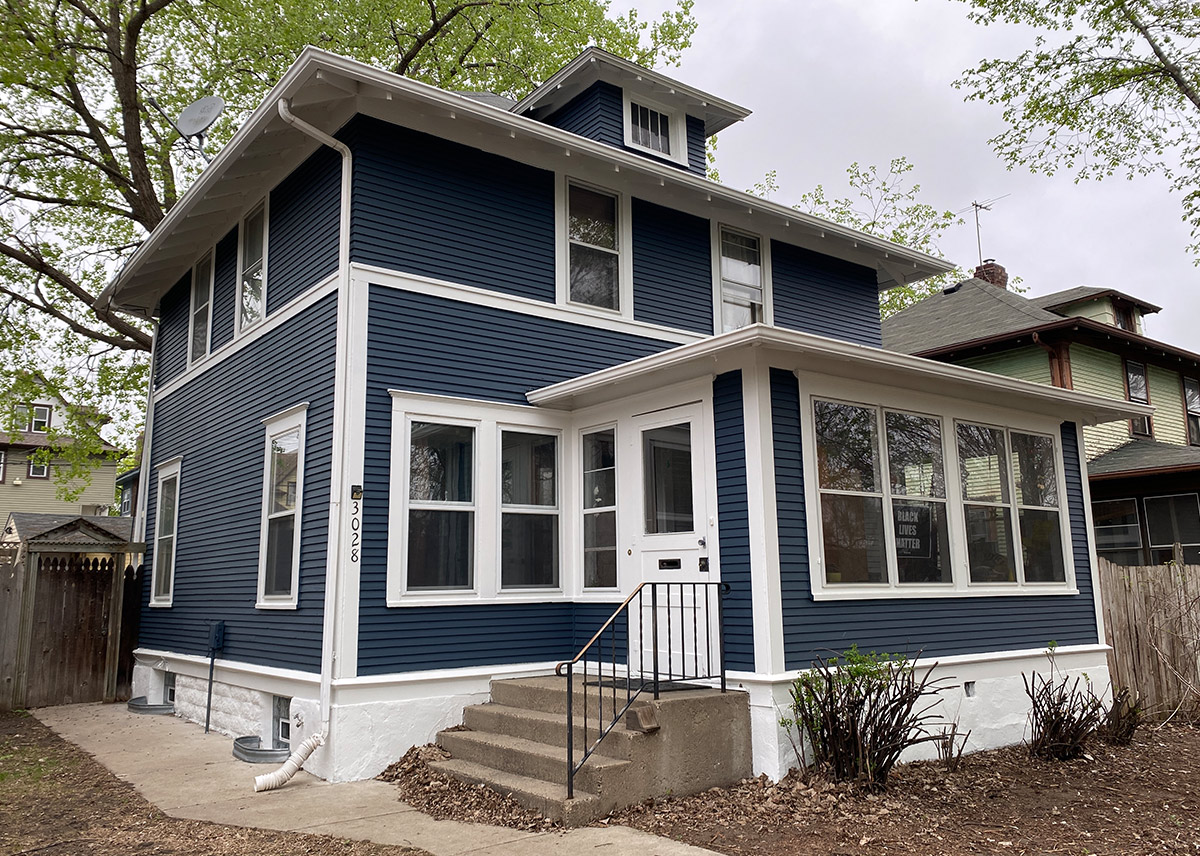
If you’ve been putting off getting your home’s exterior painted because you’re not sure what it’s going to cost, you’re not alone. It’s one of the most common questions Minneapolis homeowners ask, and it’s also one of the hardest to answer with a straight number — because the honest answer depends on more variables than most people expect. What you’ll find below isn’t a watered-down estimate pulled from a national average. This is a real breakdown of what exterior painting in Minneapolis specifically, why those costs are what they are, and what separates a paint job that lasts from one that starts failing before the second winter rolls around.
What Minneapolis Homeowners Are Actually Paying
Let’s start with the number you came here for. In the Minneapolis metro area, most homeowners should budget somewhere between $7,000 and $15,000 for a full exterior paint job on a single-family home. That range is wide on purpose, because an 1,100-square-foot rambler in Richfield is a fundamentally different project than a three-story Victorian in Prospect Park. For larger or more detailed homes, costs can push past $15,000 and still represent fair, honest pricing from a quality crew.
The national average you’ll often see cited — somewhere around $5,000 to $7,500 — consistently underestimates what it actually takes to do the job right in this climate. Minnesota is not Atlanta. It’s not Phoenix. The freeze-thaw cycle here is aggressive, and paint that isn’t applied correctly — with proper prep, the right products, and enough dry time — will begin to peel, bubble, and fail within a season or two. Paying a lower price upfront and repainting in three years ends up being significantly more expensive than paying a fair price for a job done correctly the first time.
Why Square Footage Is Only Part of the Equation
Most contractors will start a quote by measuring your home’s paintable surface area. That calculation accounts for the exterior walls, but it doesn’t capture everything that drives the final price. A 2,200-square-foot home with clean, flat LP siding is a straightforward job. A 2,200-square-foot home with intricate trim work, multiple gable peaks, a wraparound porch, brick accents, and original cedar clapboard is an entirely different animal — and it should cost more.
Here’s what actually adds to a quote beyond raw square footage: the number of stories (working off ladders and scaffolding at height takes longer and adds safety cost), the condition of the existing paint (significant peeling means more scraping, sanding, and primer work before a brush ever hits the siding), the type of siding material (wood, fiber cement, vinyl, stucco, and brick all have different prep and paint requirements), the number of colors (a single-color paint job is faster than a body-plus-trim-plus-accent scheme), and accessibility around the home (tight side yards, mature landscaping, and attached structures all slow a crew down).
The Prep Work Is Where the Money Goes — And Where It Should
One of the most important things to understand about exterior painting is that the visible paint you see when the job is done is maybe 30 percent of what determines whether it lasts. The other 70 percent is the surface prep underneath it. Power washing, hand scraping peeling areas, sanding rough edges, filling cracks and nail holes, caulking around windows and trim, priming bare wood — all of that has to happen before a drop of finish coat goes on, and it takes time.
In Minneapolis, where temperatures regularly drop below zero in winter and summer humidity can spike well above 70 percent, siding expands, contracts, and flexes more than in most parts of the country. Any gap that isn’t caulked, any surface that isn’t properly primed, any section of bare wood that doesn’t get sealed becomes a point where moisture gets in. Once moisture is behind the paint film, you’re dealing with peeling paint at best and wood rot at worst. A contractor who is cutting their quote by skipping prep is not saving you money — they’re charging you to do the job twice.
What High-Quality Paint Actually Costs (And Why It Matters)
There’s also a meaningful price difference between products, and a trustworthy contractor will be transparent about what they’re using. Premium exterior paints from brands like Sherwin-Williams and Benjamin Moore — specifically products like Duration, Emerald, or Aura Exterior — run $80 to $100 per gallon or more. These aren’t luxury upgrades for their own sake. In a Minnesota climate, a paint that builds a thick, flexible film with strong UV resistance and mildew resistance is a practical necessity, not a splurge. Cheaper paint formulations are thinner, less flexible, and less resistant to the kind of temperature swings that happen between January and July here.
When you’re getting quotes, ask what paint the contractor is using and what the dry mil thickness will be. A professional crew should apply two finish coats, and on bare or previously problematic surfaces, a coat of bonding primer before that. If a contractor is vague about products or tells you they’ll “use whatever you want,” that’s a yellow flag. A painter who knows what they’re doing has strong opinions about products because they’ve seen the difference it makes over time.
Timing and Seasonality in Minneapolis
Exterior painting in Minneapolis is constrained by the weather in ways that don’t apply in warmer climates. Most exterior paints require temperatures to stay above 50 degrees Fahrenheit during application and for several hours afterward as the paint cures. That window in Minnesota typically runs from late April through October — and even within that window, spring and fall can be unpredictable.
This means demand for exterior painting is compressed into a shorter season than most of the country, and quality crews book up fast. If you’re hoping to get your home painted during the prime summer window — when the weather is most reliably cooperative — reaching out in March or April to lock in a spot is not too early. Waiting until July to start calling usually means settling for whoever still has availability, which isn’t always the painter you want.
There’s also a real argument for painting in late summer or early fall if your goal is longevity. Humidity tends to be lower in August and September than in June, which helps paint cure more evenly. Cooler temperatures also slow the drying process slightly, which actually allows paint to level and bond better than it does in peak summer heat. An experienced Minneapolis painter will know how to read conditions and schedule accordingly.
What Separates a Good Contractor from a Great One
Price matters, but it’s not the whole picture. The difference between a good exterior painter and a great one usually shows up in the details — how thoroughly they prep, how carefully they protect your landscaping and windows, whether they backbrush after spraying (which is essential for good adhesion on most surfaces), how they handle unexpected issues like rot discovery mid-project, and how responsive they are from the first conversation through the final walkthrough.
Great painters also give you a written, itemized proposal. Not a number on a sticky note. A document that tells you what surfaces are being painted, what prep is included, what products are being used, how many coats are going on, what the payment schedule looks like, and what kind of warranty they’re standing behind the work with. If a contractor won’t put those details in writing, walk away.
Headwaters Painting Is Worth a Conversation
If you’re a Minneapolis homeowner who wants the job done right the first time, Headwaters Painting is a name worth knowing. They specialize in exterior work in the Twin Cities metro, and their approach is built around the kind of thorough prep and quality materials that actually hold up through Minnesota winters. They’re not the cheapest option — and that’s a feature, not a bug. When you’re trusting someone with one of the most visible and weathered surfaces of your home, cheap is a risk. Headwaters brings the attention to detail and local climate knowledge that makes a real difference in how a paint job holds up two, five, and ten years out.
Reaching out for a quote doesn’t commit you to anything, and a conversation with their team will quickly tell you whether they’re the right fit for your project. Given how competitive the summer schedule gets, the earlier you start that conversation, the better your options are going to be.
The Bottom Line
A well-executed exterior paint job in Minneapolis is an investment in the long-term health of your home. It protects the wood and siding underneath from moisture infiltration, it boosts curb appeal in a real and immediate way, and it’s significantly less expensive than the repairs that come from neglecting a failing paint surface for too long. Budget honestly — plan for the $7,000 to $13,000 range for most homes, more for larger or more detailed properties — and spend that money with a crew that knows what they’re doing. In a climate as demanding as Minnesota’s, the craftsmanship behind the paint matters as much as the paint itself.