
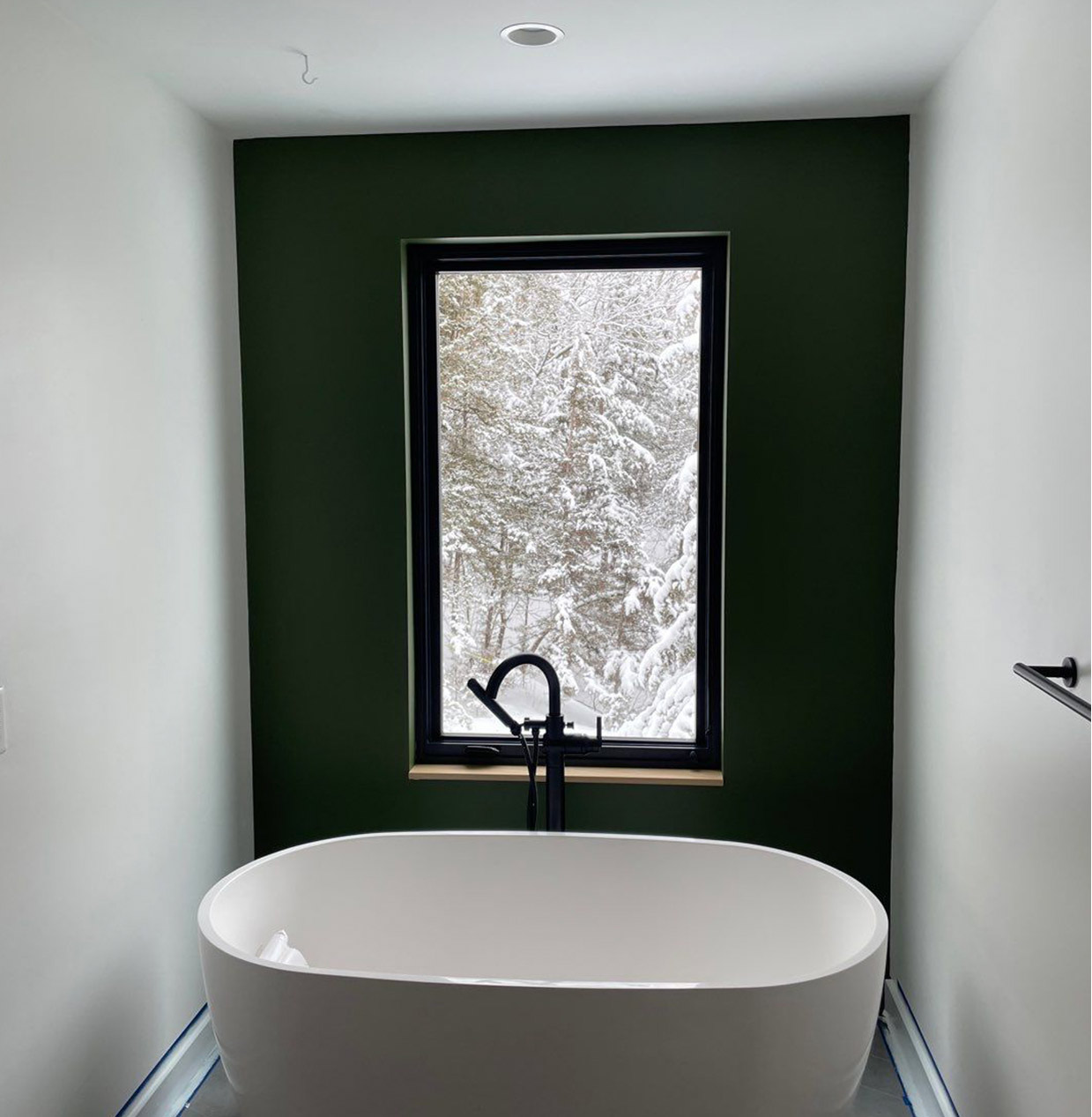
The bathroom sheen debate has been reduced to a simple formula repeated across every home improvement website on the internet: use semi-gloss in bathrooms because it resists moisture. That advice isn’t wrong, but it’s so oversimplified that it leads thousands of homeowners to make sheen decisions based on a single variable while ignoring the half-dozen other factors that actually determine whether their bathroom paint thrives or fails. The reality is that both satin and semi-gloss can perform well in a bathroom, and both can fail miserably, depending on the specific moisture dynamics of the space, the ventilation infrastructure, the wall substrate, and the Minneapolis climate conditions that make our bathrooms behave differently from bathrooms in milder, more humidity-stable regions. Choosing the right sheen for your bathroom isn’t about memorizing a rule. It’s about understanding what moisture actually does to a paint film at the microscopic level and then matching your sheen choice to the specific demands your bathroom places on that film every single day.
The Moisture Reality Inside a Minneapolis Bathroom
Before comparing sheens, it’s worth understanding exactly how extreme the moisture environment inside a bathroom actually is, because most homeowners dramatically underestimate it. A standard ten-minute hot shower generates roughly half a pint of airborne water vapor, raising the relative humidity inside a closed bathroom to between eighty and one hundred percent. That’s tropical rainforest territory, and it happens in a small enclosed space where every wall, ceiling, and surface is subjected to direct moisture contact. Within minutes of the shower ending, that humidity begins dropping, especially in winter when the dry forced-air heating system in your Minneapolis home aggressively pulls moisture out of the air. On a January evening, your bathroom can swing from ninety-five percent humidity during a shower to twenty-five percent humidity within two hours of the shower ending.
This isn’t just a humidity fluctuation. It’s a rapid, dramatic moisture cycle that repeats once or twice daily for the entire life of your paint job. Every cycle forces the paint film to absorb moisture and swell during peak humidity, then release that moisture and contract as the room dries out. Over the course of a single Minneapolis winter, your bathroom walls go through roughly one hundred fifty to two hundred of these expansion-contraction cycles, each one stressing the paint film’s elasticity and testing the adhesion bond between the coating and the wall surface beneath it. This is the environment your sheen selection has to survive, and it’s far more demanding than the generic “bathrooms are humid” framing that most paint guides offer.
How Sheen Level Actually Interacts with Moisture at the Film Level
The reason sheen matters in wet spaces comes down to the physical structure of the dried paint film at a microscopic scale, and this is where the conversation gets more nuanced than simply saying higher sheen equals better moisture resistance. When paint dries and coalesces, the resin particles fuse into a continuous polymer film. In lower-sheen products like satin, the formulation includes flatting agents, which are tiny particles, often silica-based, that are distributed throughout the film to scatter light and reduce reflectivity. These flatting agents create microscopic surface irregularities and also introduce slight discontinuities within the body of the film itself. The result is a paint surface that is marginally more porous and textured than its higher-sheen counterpart.
Semi-gloss formulations contain fewer flatting agents, producing a film that is smoother on the surface and more continuous internally. This denser film structure does two things that matter in a bathroom: it slows the rate at which moisture vapor can penetrate through the film to reach the wall substrate, and it presents a smoother surface that sheds condensed water droplets more effectively rather than allowing them to sit and soak in. The difference is real and measurable, but it’s also more modest than most people assume. Modern premium satin paints have significantly better moisture resistance than the satin formulations of even ten years ago. Advances in resin technology have closed much of the performance gap, meaning today’s high-quality satin performs closer to yesterday’s semi-gloss than many homeowners or even painters realize.
Where Semi-Gloss Earns Its Reputation
There are specific bathroom conditions where semi-gloss remains the clearly superior choice, and these conditions are common enough in Minneapolis homes that the traditional recommendation still has strong merit. The first is direct splash zone exposure. Walls immediately adjacent to the shower or bathtub, particularly in bathrooms without a full shower enclosure or glass door, receive direct water contact regularly. Liquid water on a paint surface is a fundamentally different challenge than water vapor in the air. When water droplets sit on a satin surface, they have more time to penetrate the film through the micro-texture created by flatting agents. On a semi-gloss surface, the same droplets bead and run off more readily because the smoother film doesn’t give water as many entry points. For walls within the direct splash radius of a shower, semi-gloss provides a meaningful durability advantage.
The second condition is inadequate ventilation. Many older Minneapolis homes, particularly the Craftsman bungalows, Victorians, and early twentieth-century four-squares that define neighborhoods like Longfellow, Standish, and Northeast, have bathrooms with undersized or absent exhaust fans. Some rely on a single operable window for ventilation, which is functionally useless during a Minneapolis winter when no one is opening a bathroom window in subzero temperatures. In these poorly ventilated bathrooms, post-shower humidity lingers far longer than in homes with modern ventilation. The extended moisture exposure time amplifies every weakness in the paint film, and the denser, less porous film structure of semi-gloss provides a measurable buffer against prolonged humidity that satin can’t match. If your bathroom exhaust fan is weak, noisy, or nonexistent, semi-gloss is the safer choice for the entire room, not just the splash zones.
The third condition involves ceiling applications. Bathroom ceilings endure the worst moisture conditions in the room because hot, humid air rises and concentrates at ceiling level. Condensation frequently forms directly on the ceiling surface, especially during winter when the ceiling plane may be cooler due to inadequate attic insulation above. Semi-gloss or even high-gloss on the bathroom ceiling provides the most durable, mildew-resistant surface for the hardest-hit plane in the room. This is one area where professional painters almost universally agree regardless of what sheen is used on the walls.
Where Satin Makes a Strong Case
Despite semi-gloss’s advantages in high-moisture conditions, satin has legitimate strengths in bathroom applications that go beyond simple aesthetics, though the aesthetic factor is significant enough to deserve honest acknowledgment. Semi-gloss reflects light aggressively, and in a bathroom, that reflected light bounces between mirrors, tile, chrome fixtures, and glossy surfaces to create a bright, sometimes harsh visual environment. More importantly for the paint itself, semi-gloss highlights every wall imperfection with unforgiving clarity. Drywall seams, previous patches, subtle texturing inconsistencies, and even minor roller stipple patterns all become prominently visible under the reflective sheen of semi-gloss. In older Minneapolis homes where bathroom walls have accumulated decades of repairs, nail pops, and plaster irregularities, semi-gloss can make a freshly painted room look worse by exposing every flaw in sharp relief.
Satin’s lower reflectivity softens these imperfections significantly, delivering a finished look that reads as smooth and uniform even over less-than-perfect substrates. For bathrooms in older homes where extensive skim-coating or wall replacement isn’t in the budget, satin provides a dramatically better visual result on the same wall surface.
Beyond aesthetics, modern premium satin formulations have narrowed the functional performance gap considerably. Current-generation kitchen and bath satin products from major manufacturers use advanced cross-linking resin systems that produce a denser, more moisture-resistant film than standard satin lines. These specialized formulations also include integrated antimicrobial additives that inhibit mold and mildew growth within the paint film itself, addressing one of the primary biological concerns in bathroom environments. When a premium kitchen and bath satin product is applied over proper primer on a well-prepared surface, its real-world moisture performance in a reasonably ventilated bathroom approaches that of semi-gloss, while delivering a far more forgiving visual finish.
The Minneapolis Climate Wrinkle: Why Seasonal Extremes Change the Calculation
The Twin Cities climate introduces a variable that generic bathroom paint guides don’t account for, and it cuts in favor of higher sheen more strongly than national recommendations suggest. The extreme winter humidity cycling described earlier, with daily swings from near-saturation to desert-dry conditions, places unusual fatigue stress on bathroom paint films. Every moisture absorption and release cycle tests the film’s elasticity and substrate adhesion. Over multiple winters, this cyclical stress accumulates as micro-fatigue in the paint film, similar to the way bending a piece of metal back and forth eventually causes it to weaken and fracture even though no single bend was enough to break it.
Semi-gloss films, with their denser internal structure and lower porosity, absorb and release less moisture per cycle than satin films. This means the total magnitude of each expansion-contraction event is smaller in semi-gloss, reducing the cumulative fatigue damage per winter season. Over a five-year period in a Minneapolis bathroom, this difference compounds into a meaningful longevity advantage for semi-gloss, particularly on exterior-facing walls where the temperature differential makes the moisture cycling even more extreme. Satin can still perform well over this timeline, but it requires a premium formulation, proper primer, and functional ventilation to keep pace. Semi-gloss is more forgiving of imperfect conditions because its film structure inherently buffers against the environmental stress that Minneapolis winters impose.
The Strategic Approach: Using Both Sheens Where They Perform Best
The most sophisticated approach to bathroom painting, and the method professional painters often recommend, is to use both sheens strategically within the same room rather than defaulting to a single sheen everywhere. Semi-gloss is applied to the highest-demand surfaces: the ceiling, the walls within the direct splash zone adjacent to the tub or shower, the wall behind the toilet, and any exterior-facing wall where winter condensation pressure is highest. Satin is used on the remaining walls, typically the vanity wall, any interior partition walls, and areas farther from direct water exposure. This approach captures the durability advantages of semi-gloss where they matter most while preserving the visual warmth and imperfection-forgiving qualities of satin across the broader visual field of the room.
The key to making this dual-sheen approach work is color matching. Both sheens should be the same color from the same product line, and ideally the same formulation family. Even then, the difference in light reflection between satin and semi-gloss walls will create a subtle visible distinction. Professional painters manage this by placing the sheen transition at natural visual break points, such as inside corners, where the eye naturally expects a slight change in light behavior. Done well, the transition is invisible to anyone who isn’t specifically looking for it, and the room benefits from optimized performance on every surface.
Let Our Team Take the Guesswork Out of Your Bathroom Project
Choosing the right sheen for your bathroom involves more than picking a label off the shelf, and the stakes are higher than in any other room in your home because no other space punishes the wrong choice as quickly or as visibly. Headwaters Painting helps Minneapolis homeowners navigate these decisions every day, evaluating your specific bathroom conditions — ventilation quality, wall substrate, moisture exposure patterns, and the unique demands of our Twin Cities climate — to recommend the sheen strategy, product formulation, and surface preparation that will deliver a beautiful, durable result built to handle years of daily steam, splashes, and seasonal extremes. Contact us today to schedule your free estimate and let our team design a bathroom paint system that looks as good in year five as it does on day one.